
Fundraising · a practical event plan
Plan a Lotería fundraiser your community can make its own.
A full table is a good start. A clear purpose, a realistic budget and a game your guests recognize turn the evening into something worth showing up for.
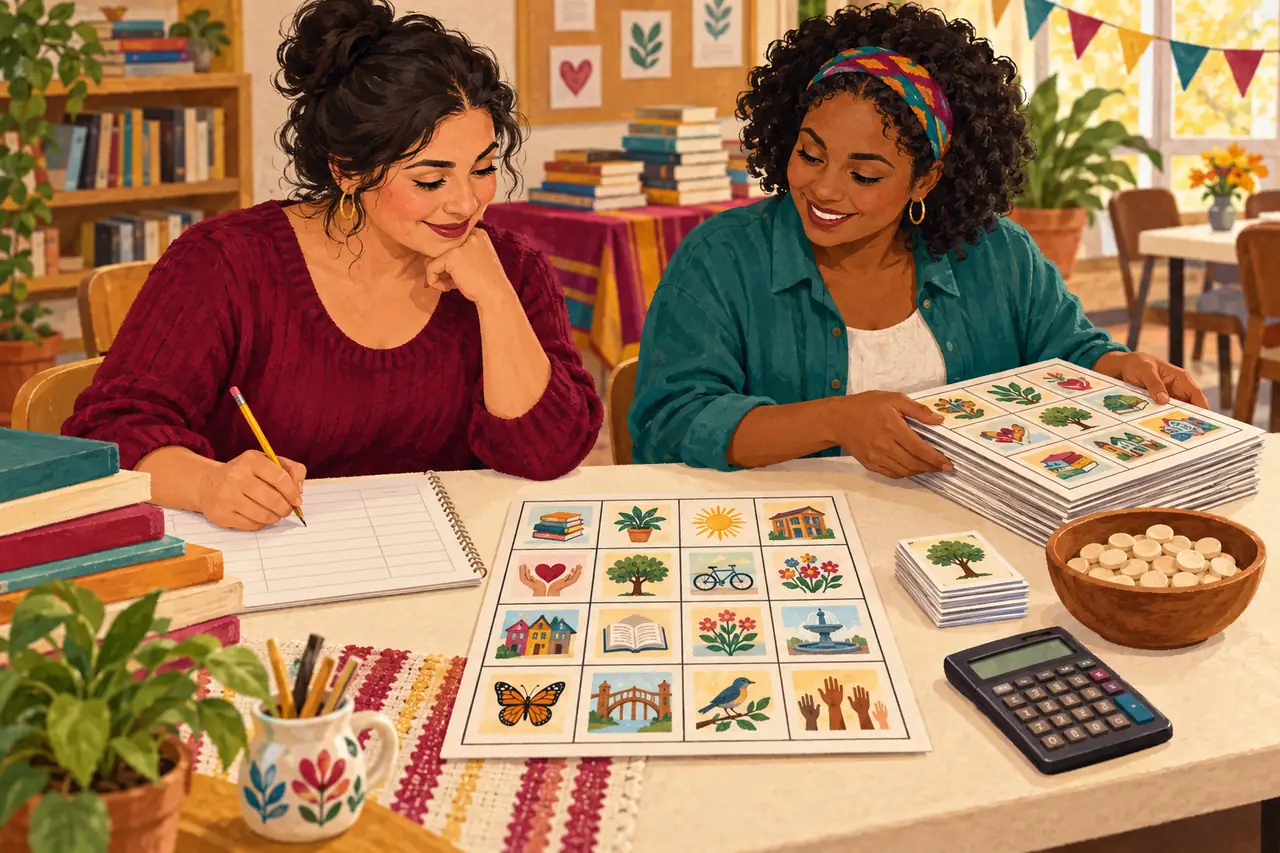
Leer esta guía en españolSomeone brings the coffee. Someone knows which closet holds the folding chairs. Someone always remembers the extra markers. A Lotería fundraiser can bring that same community energy to a specific goal, whether it is books for a classroom or supplies for a neighborhood program.
Start with the event plan, not the payment button: name the purpose, check the rules for your location, count your players and choose how the game will be made. This guide gives your organizing team a practical place to begin.
In this guide
Editorial illustration
A game you can make your own
Agree on the purpose and check the rules first
Write one sentence everyone can explain: “We are raising money for new books in our reading room.” Name who receives the funds, who keeps the records and who approves the event. Keep that purpose visible on the invitation and explain it again at the welcome.
Before advertising paid entry, prizes, raffles or paid game rounds, check the rules with your organization and the relevant local authority. Charitable gaming requirements vary by location and event format; nonprofit status or a Maker discount is not an event permit. Calling an entry payment a donation does not settle the question. Ask an appropriate adviser about financial reporting when needed.
Make the budget before promising the proceeds
Here is an illustrative worksheet, not a forecast or a recommended ticket price. Suppose an organizer has confirmed that its planned format is permitted and budgets for 40 attendees contributing $10 each. That is $400 in gross receipts, before costs. It is not $400 raised for the cause.
Example costs: $30 for the game and printing, $45 for refreshments, $40 for prizes, $25 for venue or equipment, $20 for fees or other event costs, and a $40 contingency. Total budgeted costs: $200. In this example, $400 minus $200 leaves $200 for the stated purpose. Replace every number with actual quotes and include any permits, taxes or other required costs; attendance and proceeds are not guaranteed.
Use a second, quieter-night version of the budget. If fewer people arrive, which costs stay the same? Record donated supplies separately rather than assuming you will get them. Keep receipts and reconcile the actual income and expenses after the event.
- Expected receipts: confirmed sponsorships or donations plus permitted event income.
- Costs: game access, printing, cutting, markers, venue, food, prizes, fees and contingency.
- Expected amount for the cause: receipts minus all costs.
- Named person responsible for payments, records and the final event summary.
Count player boards, not calling cards
Each player or pair needs a board, also called a tabla. The caller uses one separate matching deck. A deck with 54 calling cards does not mean the set has 54 player boards. Decide whether guests play individually or in pairs before ordering or printing.
For 40 individual players, prepare 40 different boards and one complete calling deck. For 60 guests playing in pairs, prepare 30 different boards. A new project pass supports up to 50 boards; an active membership supports up to 100 per project. If more than 100 people want individual boards, plan separate rounds or groups rather than promising one project with more than 100.
Printing the same board twice does not create another unique arrangement. Even different boards can win on the same call, so decide how ties will work before play begins. Keep the deck and boards from the same finalized project together.
Build the game around the people and places you know
Your deck can celebrate a reading room, a garden, a neighborhood mural or the volunteers who make the work happen. Original card ideas might include La Biblioteca, El Jardín, La Voluntaria and La Comunidad. These are prompts for your own design, not an included deck or an official partnership.
Use photos, drawings and names you have permission to share. Get consent before featuring recognizable people, follow school rules for student images and avoid turning someone’s personal circumstances into a game card. Objects and places can tell a community story without identifying anyone.
In Maker, add your images in Cards, check the labels and crops, then use Board Design to choose the layout. Generate the board quantity your access allows, inspect the preview and save a final set before downloading. A 4 × 4 board needs at least 16 different cards; a larger deck gives you more variety.
Give each volunteer a clear job
You do not need a large committee, but you do need to know who is doing what. A welcome person can help newcomers find a seat; the caller keeps the round moving; a table helper explains the pattern; and the finance lead handles the event records. One person can cover more than one role if the room is small.
A sample 75-minute program: 15 minutes to welcome guests and explain the purpose, 10 minutes for instructions and a practice round, 35 minutes for play and a short break, then 15 minutes for thanks, the next step and cleanup. Adjust for your group. Leave room for conversation rather than rushing through as many rounds as possible.
- Show one winning pattern and explain the tie rule before drawing a card.
- Read the label, hold up the picture and pause; bilingual calling needs time.
- Lay called cards face up so a claimed win can be checked.
- Offer help without putting a first-time player on the spot.
Set a printing deadline that leaves room for a test
If you are printing yourself, open the exported files and print one page at the intended size before committing to the full set. Check the labels, image crops, edges and contrast. Then allow time to print, cut and pack one matching deck with the boards.
Prefer a shipped set? You can build and save a free draft, then choose “Order a printed set” in the builder when the design is ready. A project pass is not a prerequisite for placing that physical order. Choose the 50- or 100-board option and review the current price, shipping and delivery timing. Printed orders do not automatically include digital-download access.
One event, or a calendar full of them?
Start a draft and preview your design free. A new project pass covers one project, up to 50 boards with the Lotería Maker logo, 30 days from purchase to edit, and three final saves. Downloads of the saved final set do not use another save. Approved educators and nonprofits can buy a pass for $4.99 USD without a subscription.
For recurring events, an active paid membership includes unlimited Studio projects, up to 100 boards per project, unlimited edits and final saves, and logo-free exports. You can use your own permitted images or available Y&L catalog themes in Studio. Ready-made shop downloads are separate purchases; catalog artwork cannot be resold.
The nonprofit pricing page explains monthly and annual rates, renewals and approval. Sign in with the approved account and compare the current checkout price before paying. Printing, shipping and optional AI credits are separate.
A free event planner to print and share with your team
Bring the plan to the table. These two pages give you space for the event details, volunteer roles and running order, plus a blank budget and setup checklist. Fill in your own figures and confirm your event’s requirements separately. The planning notes on this page remain available too.
Download free, without an account, email address or purchase. This is a static PDF to print and complete by hand, not an interactive form or calculator. It contains planning worksheets, not Lotería cards or player boards.
Copy this fundraiser planning worksheet
Copy these prompts into your team notes, or use your browser’s Print command to keep this guide. Fill them in before you advertise; this is a planning worksheet, not a downloadable game.
- Purpose and beneficiary: ____________________
- Date, location and organizer contact: ____________________
- Event-format approval and required checks: ____________________
- Players or pairs / different boards needed: ____________________
- Budgeted receipts / all costs / amount for the cause: ____________________
- Game design, access choice and printing deadline: ____________________
- Welcome / caller / table help / finance lead: ____________________
- Languages, access needs, winning pattern and tie rule: ____________________
- After the event: reconcile receipts, thank helpers and report the actual result.