
Community nights · English y español
Host a bilingual Lotería night where everyone has a place.
For the neighbor who knows every call and the guest who has never played: a shared picture, a little time and a warm welcome go a long way.
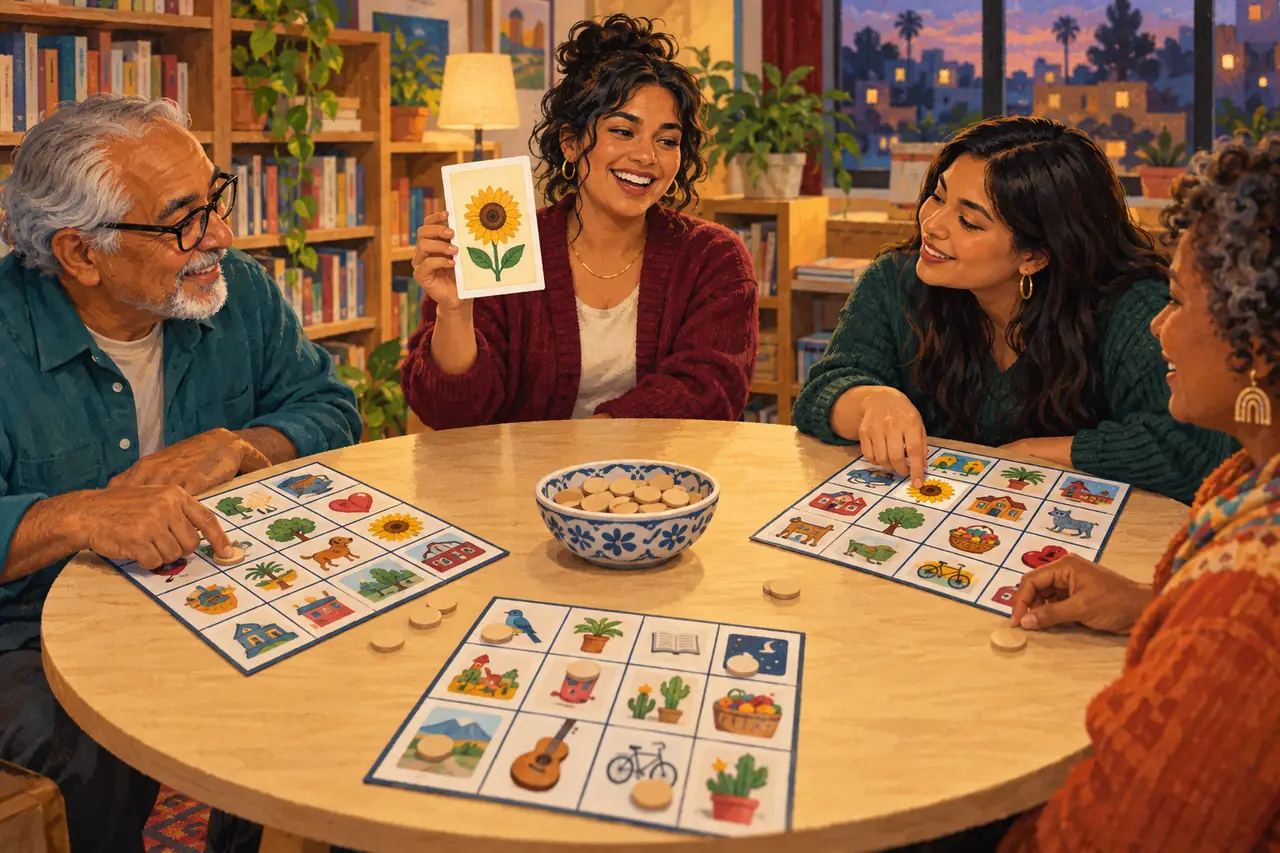
Leer esta guía en españolThe best moment is not always the winning call. Sometimes it is a newcomer finding a seat, a child helping a grandparent spot a picture, or two neighbors discovering they have a story in common. A community Lotería night can make space for those moments without asking everyone to speak the same language.
This guide is for a welcoming game night, not a fundraising formula. Use it for a library gathering, a school family night or a neighborhood group. If you plan paid play or prizes as a fundraiser, use the separate fundraising guide and check the requirements for your event.
In this guide
Editorial illustration
A game you can make your own
Plan for the people who will actually be there
Ask about language and access needs when you invite people, without making them explain personal circumstances. Say whether the event is free, where to enter, how long it will last and whether people can arrive late. Do not assume every Latino guest speaks Spanish or already knows Lotería.
Choose a room with a clear route to the tables and a caller people can see and hear. Keep music low during play. Set aside a place for someone who wants a quieter table, and welcome people who prefer to watch before joining.
- A visible welcome person and clear directions to seating.
- Table space for boards, markers and mobility devices.
- A way to see the called card as well as hear its name.
- Optional pairs, a practice round and no pressure to translate or speak.
Choose images people can share a story about
A custom deck can include the library, a garden, a favorite local landmark or the objects your group uses every day. La Biblioteca, El Libro, El Jardín and La Mesa are simple starting points. They are design prompts, not an included community deck.
Use your own images or artwork you are allowed to use, and ask before featuring recognizable people. For a school event, follow the school’s image and consent rules. You can make a very personal game with objects and places instead of faces.
Have someone comfortable in both languages review the labels. Keep each label short and recognizable at print size; two long translations squeezed into one card are harder to follow. You can also give the caller a separate bilingual reference sheet. Confirm that every name points to the same picture on the deck and boards.
Prepare one board per person or pair
For 24 individual players, set out 24 different boards and one matching calling deck. For 48 people in pairs, those same 24 boards are enough. Sharing is an option, not a requirement; ask what makes people comfortable.
A new project pass supports up to 50 boards, and an active membership supports up to 100 per project. Printing a duplicate does not make a new combination. Keep a demonstration board with the caller and agree how to handle simultaneous wins.
- Boards, the matching deck and a visible example of the winning pattern.
- Easy-to-handle markers; keep small pieces away from young children.
- A tray or clear table space for the cards already called.
- A test print checked for readable text, contrast and complete images.
- A volunteer who can help at a table without taking over the game.
Use a short opening in English and Spanish
English: “Welcome! We will play one practice turn first. Today the winning pattern is one horizontal row. Mark a picture only after we call it. When your row is full, say ¡Lotería! and we will check it together. You can play with a partner, and you can ask us to repeat a card.”
Español: “¡Bienvenidos! Primero haremos un turno de práctica. Hoy gana una fila horizontal. Marca la imagen después de que la cantemos. Cuando completes la fila, di ¡Lotería! y la revisamos juntos. Puedes jugar en pareja y pedir que repitamos una carta”.
Then demonstrate on a real board. A 4 × 4 board has four spaces across; it does not have a free center square. Use the pattern that actually matches your design, and explain ties before the first round.
Read it, show it, give it a moment
Shuffle the full calling deck. Draw one card, say its reviewed names in both languages and hold up the picture. For example, if your own card is labeled El Libro, you might say “El Libro. The Book.” Pause before moving on. There is no need to invent a rhyme.
Put each called card face up. Do not return it to the deck during the round. If someone calls ¡Lotería!, compare their marked pattern with the cards already drawn. Congratulate them, explain any missed picture kindly and follow the tie rule you announced.
After a round, let people clear their boards and reshuffle the complete deck. Offer a brief break or another caller. Keep language practice optional: a community game is not a test of pronunciation, reading speed or belonging.
Keep the evening easy to follow
Try a 60-minute outline: 10 minutes to welcome and find seats, 10 for the demonstration and practice, 30 for games with a short break, and 10 for thanks and cleanup. Treat it as a starting point rather than a strict timer.
Before people leave, invite a simple suggestion: “What picture should we add next time?” You do not need to collect personal stories or photographs to get useful ideas. Ask permission before photographing the gathering or publishing a story about it.
One event, or a calendar full of them?
Start a draft and preview your design free. A new project pass covers one project, up to 50 boards with the Lotería Maker logo, 30 days from purchase to edit, and three final saves. Downloads of the saved final set do not use another save. Approved educators and nonprofits can buy a pass for $4.99 USD without a subscription.
For recurring events, an active paid membership includes unlimited Studio projects, up to 100 boards per project, unlimited edits and final saves, and logo-free exports. You can use your own permitted images or available Y&L catalog themes in Studio. Ready-made shop downloads are separate purchases; catalog artwork cannot be resold.
The nonprofit pricing page explains monthly and annual rates, renewals and approval. Sign in with the approved account and compare the current checkout price before paying. Printing, shipping and optional AI credits are separate.
Print it yourself, or order a finished set
For self-printing, review the final files and test one page before making the whole set. Check the paper size and scaling, leave time for cutting, and pack the deck and boards together.
For a shipped set, create and save a free draft and choose “Order a printed set” in the builder when ready. You do not have to buy a pass first. The physical options are 50 or 100 boards; price, shipping and delivery timing are shown separately. Physical ordering does not automatically unlock digital downloads.
A free event planner to print and share with your team
Bring the plan to the table. These two pages give you space for the event details, volunteer roles and running order, plus a blank budget and setup checklist. Fill in your own figures and confirm your event’s requirements separately. The planning notes on this page remain available too.
Download free, without an account, email address or purchase. This is a static PDF to print and complete by hand, not an interactive form or calculator. It contains planning worksheets, not Lotería cards or player boards.
Your community-night checklist
Copy this list into your event notes or use your browser’s Print command. Keep it with the game so another volunteer can host the next gathering.
- Date, room, host and welcome person: ____________________
- Languages, access requests and optional partners: ____________________
- Players / boards / matching deck: ____________________
- Image permissions and reviewed bilingual labels: ____________________
- Print test and materials packed by: ____________________
- Winning pattern / tie rule / practice turn: ____________________
- Caller / table helpers / cleanup: ____________________
- One thing to keep and one thing to change next time: ____________________