
Civic education · vocabulary and source-checking
Civic education Lotería: explore one useful word at a time.
An agenda, a district, a public notice: familiar-looking words can still raise good questions. A picture-based activity gives people a low-pressure place to ask them.
Leer esta guía en españolUse civic education Lotería to practice words people encounter in public life, from a library notice to an election glossary. Match a picture, discuss its meaning and find where a current answer belongs. The goal is understanding, not agreement with a political position.
This workshop is neutral and open to any learner. It does not promote a candidate, party or policy, ask about political preferences or tell anyone whether, when or how they are eligible to vote. For actual election questions, use the relevant official office.
In this guide
Editorial illustration
A format for your own pictures
Choose one learning goal before the cards
Try “Recognize common civic words and identify a reliable place to check them.” That is a manageable goal for a classroom, adult-learning group or library workshop. It is different from a debate, a campaign event or a citizenship test.
Ask what language support helps the group, not how people vote or whether they are citizens. Allow listening, drawing or working with a partner. No personal political answer should be needed to finish a card or take part in the game.
18 card prompts for a neutral learning deck
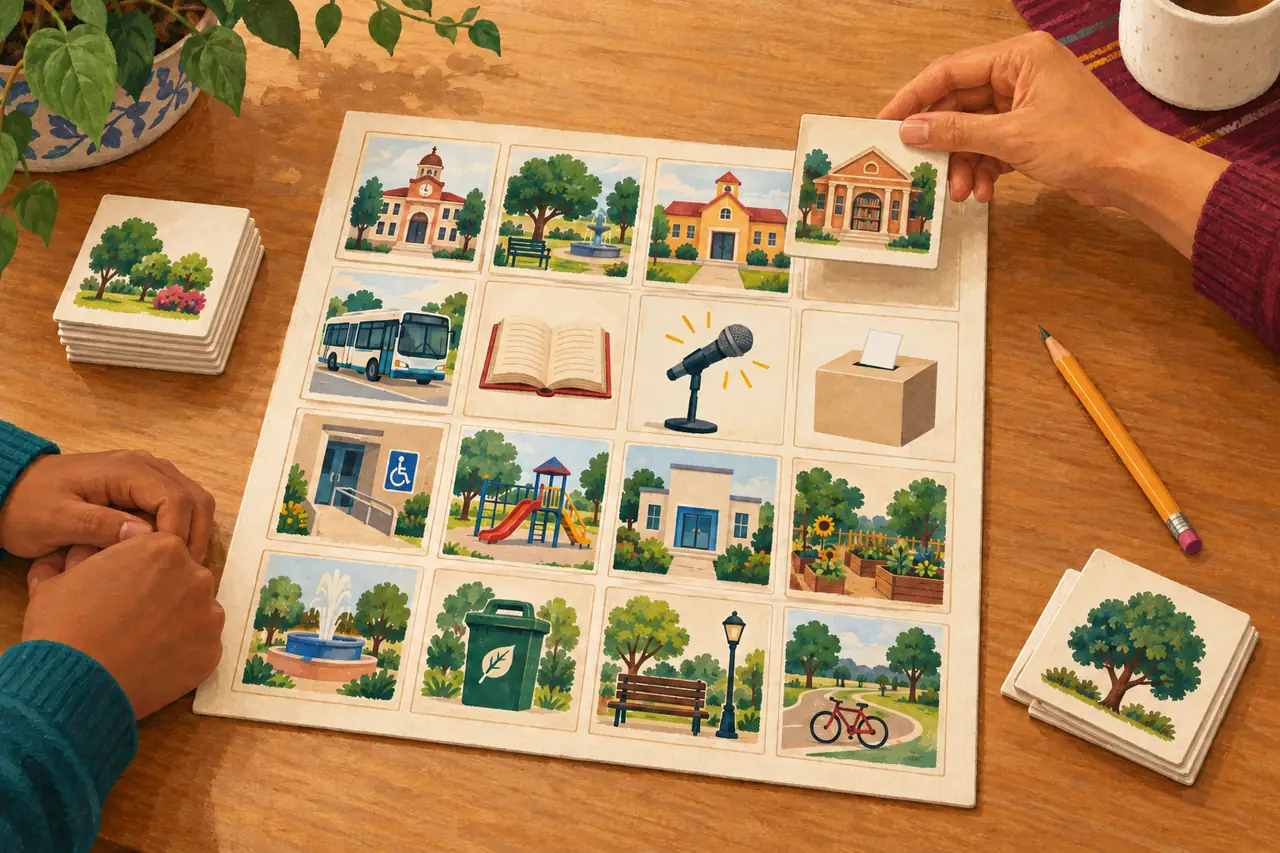
Use your own simple drawings or permitted object photos. These are design prompts, not official definitions or a downloadable deck. Adapt translations to your local terminology with a bilingual educator. An 18-card deck works with a 4 × 4 board; 5 × 5 needs at least 25 distinct cards.
- La Comunidad / The Community: an original drawing of shared spaces.
- La Biblioteca / The Library: books and a reading table.
- El Parque / The Park: a recognizable public-space illustration.
- El Ayuntamiento / City Hall: a generic building, without an official seal.
- El Servicio Público / Public Service: a simple service-counter illustration.
- La Reunión / The Meeting: chairs around a table.
- La Agenda / The Agenda: a fictional list of discussion topics.
- El Acta / Meeting Minutes: a clearly fictional meeting record.
- El Presupuesto / The Budget: sample amounts on a drawing.
- El Distrito / The District: an invented map labeled Practice.
- El Representante / The Representative: a role symbol, not a candidate portrait.
- La Pregunta / The Question: a speech bubble with a question mark.
- La Fuente / The Source: a reference book or source-note symbol.
- La Fecha / The Date: a calendar without a real election deadline.
- El Contacto / The Contact: a blank contact-card illustration.
- El Aviso / The Notice: a fictional public notice.
- La Elección / The Election: a neutral word-and-picture prompt.
- La Boleta de Práctica / The Practice Ballot: a clearly labeled teaching example.
Review the words, and keep examples visibly fictional
The U.S. Election Assistance Commission provides election-terminology glossaries for reference. Use the glossary to check an election word, then consult the relevant election office when local usage or a real procedure is involved. A short label on a game card cannot replace official instructions.
Keep explanations on a separate facilitator sheet with the source and review date. Do not squeeze legal conditions, identification rules, dates or voting instructions onto the cards. Those details can change and depend on location.
Write “Practice / Práctica” on invented ballots, maps and notices. Avoid real candidate names, party logos, government seals and imitation official forms. A game choice is not a vote; nothing in this exercise is submitted to an election office.
A 45-minute session that makes room for questions
Spend 5 minutes explaining the learning goal and optional participation. Use 10 minutes to introduce the pictures, 10 for a practice round, 15 for source-checking in pairs and 5 for a closing review. Adjust the pace to the group rather than testing reading speed.
For the game, show the winning pattern, draw one matching calling card at a time, say the reviewed names and display the image. Pause for a plain-language explanation when useful. Keep the called cards visible and check a claimed win together.
For source-checking, give each pair one fictional question: “Where could we find the contact details for a local public office?” or “Which source would we use to confirm what this term means?” The task is to identify a source, not complete a government transaction or reveal a personal situation.
Show where current information lives
USAGov’s state and local government directory links to public offices and services. Its election-office directory is the appropriate handoff for real election questions. Open the relevant official page with the group if useful, but do not turn a classroom demonstration into a registration or personal-data collection exercise.
A useful closing prompt is “Which word is clearer now, and where would you check a current answer?” If a political debate starts, acknowledge the question and return to the agreed learning goal. Participants do not need to agree on an issue to practice vocabulary respectfully.
Make a draft, then choose the format
Start free in Maker: upload your own or licensed images in Cards, review the labels and move to Board Design. In Downloads, generate the quantity your access allows, inspect the set and save the final version before downloading. Test one printed page before preparing the whole batch.
A new pass covers one project, up to 50 boards with the Maker logo, 30 days from purchase to edit and three final saves. An active paid membership includes unlimited Studio projects, up to 100 boards per project, unlimited edits and final saves, and logo-free exports. Older passes retain their benefits. Check approved educational options before buying.
You can also order a printed set from a saved free draft without buying a digital pass first. Review the 50- or 100-board physical options, shipping and delivery timing. Printing, shipping, optional AI credits and ready-made shop files are separate; a physical order does not automatically unlock digital downloads.
Copy this facilitator checklist
Keep the review sheet with the deck so another educator can see what was checked. The cards should teach stable vocabulary; current local instructions belong in the official resources you link.
- Learning goal and participant choices: ____________________
- Vocabulary list / bilingual reviewer / source review date: ____________________
- Images licensed or original; fictional materials labeled Practice: ____________________
- No party, candidate or policy promotion in cards or script: ____________________
- Official references chosen; no personal information collected: ____________________
- Project owner / board count / access or printing choice: ____________________
- Final card review and test print completed: ____________________
Sources and references
- U.S. Election Assistance Commission: Election Terminology Glossaries Reference for reviewing election vocabulary, not a replacement for local official instructions.
- USAGov: State and Local Election Offices Official directory for current questions about the relevant jurisdiction.
- USAGov: State and Local Governments Directory of government offices and public-service information.