
Volunteer appreciation · notice the work behind the event
Volunteer appreciation Lotería that says, “We noticed.”
Someone stayed to stack the chairs. Someone translated the reminder. Someone made a new volunteer feel less nervous. Those are good places to begin a thank-you.
Leer esta guía en españolUse a short Lotería gathering to recognize the many ways a volunteer team contributes. The game gives people something pleasant to do together; the thank-you should still be personal enough to mean something.
This is not a competition for the most hours, the biggest donation or the loudest personality. Keep recognition separate from winning the game, make participation optional and leave people free to enjoy the evening without agreeing to another shift.
In this guide
Photographic example
An idea for bringing people together
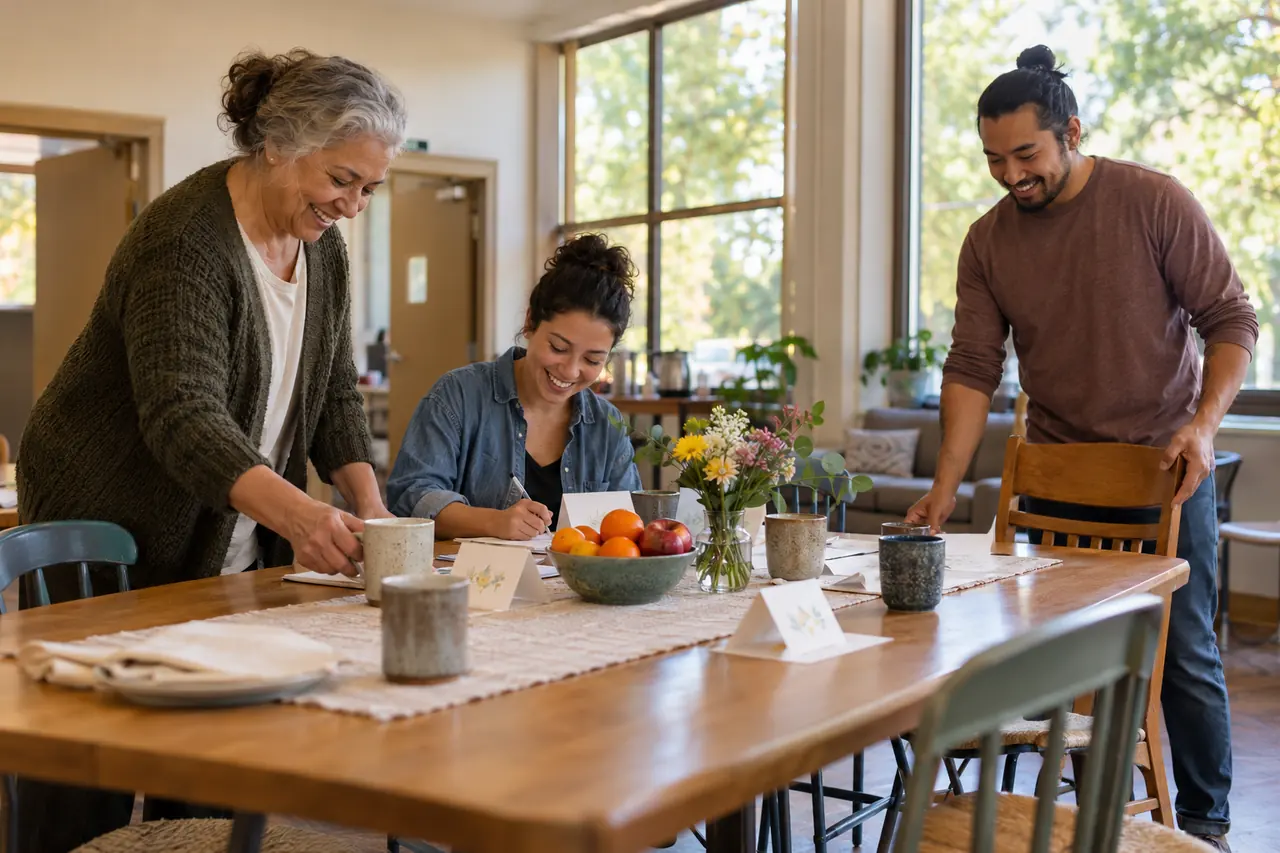
Start with something you actually noticed
Before planning the program, ask coordinators for examples of helpful work: a clear supply list, a patient explanation, a dependable handoff or an organized cleanup. Verify the detail with someone who saw it. If you do not know a person’s contribution, ask rather than filling in a flattering story.
UServeUtah’s archived appreciation guidance suggests connecting thanks to the organization’s mission, inviting feedback and writing personal notes. For this event, use a small, specific observation instead of a generic speech.
Offer the choice of a private note or public mention. Ask permission before including names, photos or personal stories in a deck or slideshow. You can recognize a kind of work with an object image, so nobody has to become a game card to be included.
Make a deck about the work, not a leaderboard
Choose original or licensed pictures of objects and shared tasks. These are starting points for your own design, not included artwork. Aim for at least 16 distinct cards for a 4 × 4 board; add more images if you want a larger calling deck.
Try these sixteen bilingual labels, and adapt them to what your team actually does. Replace a label that does not fit rather than inventing a role to fill a space.
- El Saludo / The Welcome: a friendly greeting sign.
- La Mesa / The Table: a prepared place for the next group.
- La Lista / The Checklist: a clearly organized supply list.
- La Caja / The Box: supplies sorted for the next shift.
- La Ruta / The Route: an invented map for planning a delivery.
- El Libro / The Book: materials prepared for a reading activity.
- La Regadera / The Watering Can: care for a shared garden.
- La Herramienta / The Tool: equipment returned ready to use.
- El Cartel / The Sign: directions that helped people find the room.
- La Llamada / The Call: a helpful reminder, without anyone’s contact details.
- La Escucha / Listening: a simple ear or conversation illustration.
- La Traducción / Translation: two speech bubbles.
- El Relevo / The Handoff: supplies passed to the next helper.
- El Equipo / The Team: objects arranged for a shared task.
- La Silla / The Chair: the last chair returned after an event.
- El Gracias / Thank You: a handwritten note with no personal information.
A 45-minute gathering that respects people’s time
Keep the schedule visible and invite people to skip any activity. Choose a caller who can explain the game calmly and a host who can handle thanks without turning the session into an awards ceremony.
- 0–5 minutes: welcome everyone, show the schedule and offer a seat or quieter spot.
- 5–10 minutes: give a brief, specific team thank-you and demonstrate the game.
- 10–25 minutes: play one or two relaxed rounds; show each card as it is called.
- 25–35 minutes: offer optional note-writing, conversation or time to simply sit.
- 35–42 minutes: share approved acknowledgments or distribute private notes.
- 42–45 minutes: thank the group, explain an optional feedback channel and close.
Use a prompt that makes the thanks specific
A short note works best when it describes an action and its real effect. Do not guess someone’s motives or claim an outcome you did not observe. Replace the brackets with a detail you can stand behind.
- “Thank you for [specific task]. It helped [person or team] by [observed effect].”
- “I noticed how you [action]. It made [part of the day] easier for [group].”
- “Your careful preparation of [item] meant we could [verified result].”
- “When [ordinary challenge] happened, you [action]. I appreciated [specific detail].”
- “Thank you for the work people do not always see, especially [task].”
- “One thing I learned from working with you was [real example].”
Keep recognition separate from a score
Do not put volunteer hours, donation amounts, popularity votes or attendance rankings on the cards. A person who helps occasionally may be balancing work, care or health needs that are not anyone else’s business. Thank the work you know without comparing what people could give.
If there are game prizes, keep them modest and unrelated to service recognition. An ordinary winning pattern is enough; nobody should need to disclose a personal story, speak publicly or promise future availability to participate. Provide the same appreciation note whether someone plays, watches or cannot attend.
Invite feedback privately with a practical question such as “What would make volunteering easier next time?” Do not turn the closing into a recruitment pitch. Share future opportunities separately, with a clear choice to decline.
Design free, then choose how to bring it to the event
Start a free draft in Maker. In Cards, add your own or licensed images and review the labels; then adjust Board Design. In Downloads, generate the allowed quantity, review the result and save the final version before downloading. Print one test page before the rest.
A new pass covers one project and up to 50 boards with the Maker logo: 30 days from purchase to edit and three final saves. An active paid membership allows unlimited Studio projects, up to 100 boards per project, and unlimited edits, final saves and logo-free downloads during active access. Older passes retain their benefits.
Prefer a printed set? Order 50 or 100 boards with their matching calling deck from a saved free draft, without buying a digital pass or membership first. Review the proof, current price, shipping and timing before paying. A physical order does not unlock digital downloads.
Eligible schools and organizations can request discount review. Approval is not automatic and does not make printing an included benefit. Check current pass and membership options; printing, shipping, optional AI credits and ready-made shop files are separate purchases.
A small host checklist
Ask a second organizer to check the names and spelling on any approved notes. Keep the final board and calling deck together, and leave time for a test print. It is better to send a thoughtful note later than to invent a rushed compliment.
- Verified examples of service and preferred recognition style: ____________________
- Permission for any names, photos or public mentions: ____________________
- Caller, accessible room, supplies and finish time: ____________________
- Matching deck, board count and test print: ____________________
- Private notes for people who cannot attend: ____________________
Sources and references
- UServeUtah: 10 Free Ways to Show Volunteer Appreciation (archived, 2021) Further reading on specific thanks and volunteer feedback; an archived article, not a current program offer.