
School family night · a shared table, not another meeting
A school family Lotería night with room for everyone.
A child spots the school garden. An abuelo recognizes the picture before the word is called. A caregiver who arrived alone finds a seat. Start with those small moments.
Leer esta guía en españolA school family Lotería night brings children and the people who care for them around the same game. This plan is for a PTA, PTO or school team hosting a friendly social hour, not a classroom assessment or a fundraising program.
Keep the promise simple: an easy welcome, a short explanation and a game that people can join without already knowing the school, Spanish or Lotería. Families should leave knowing someone’s name, not feeling they attended another orientation.
In this guide
Photographic example
An idea for bringing people together
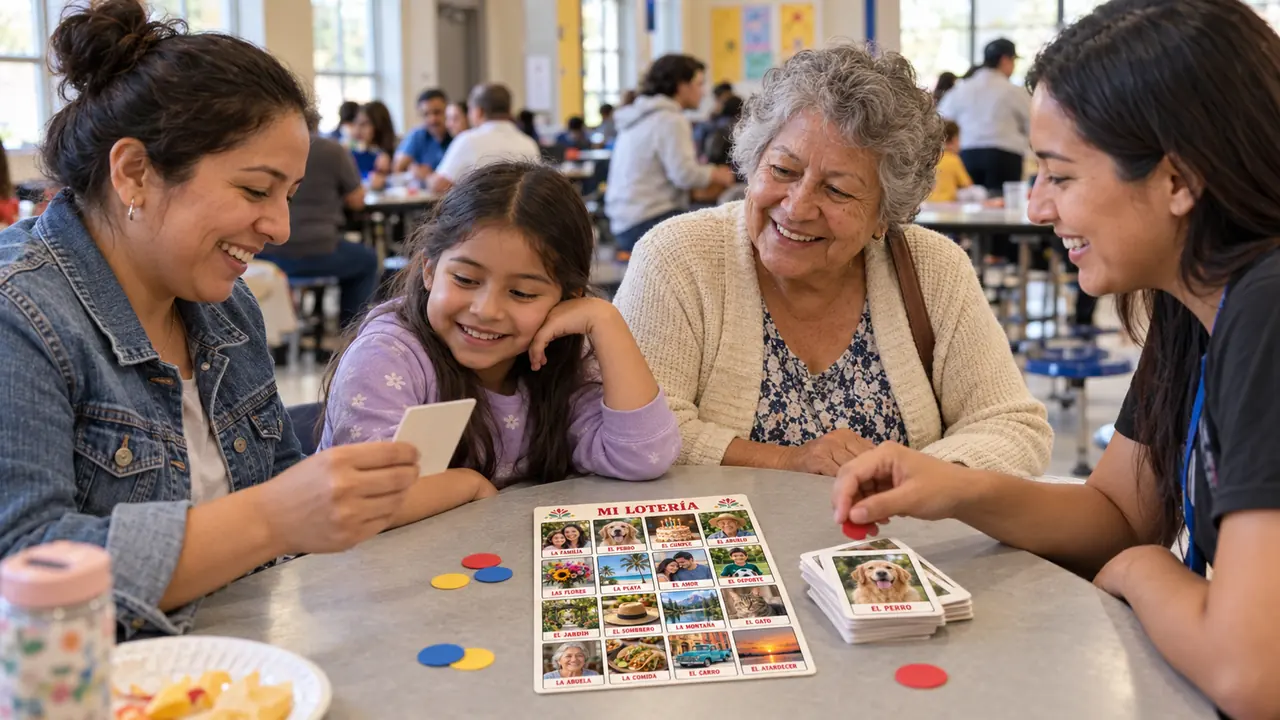
Make the welcome part of the plan
Write “families and caregivers,” not only “moms and dads.” Include grandparents, guardians and other caring adults. Have a greeter near the entrance who can point out the room, restrooms and a place to sit. A bilingual helper can explain a first round without making someone ask in front of the room.
The National PTA’s family-school partnership flier recommends welcoming families in their languages and offering low- or no-cost activities. Use that as a planning lens, then ask your own school community what would make the evening easier to attend.
Confirm accessible entry, clear aisles and usable table seating with the school. Offer a quieter table where the caller can still be heard or seen. Let people watch, work in pairs or join after a round begins. These are choices, not a separate “special” version of the event.
Keep the kit small and the roles clear
You need player boards, the matching calling deck, paper-square markers, a visible example of the winning pattern and a way for everyone to hear the caller. Borrow tables and use the school’s approved communication channels. Decorations, prizes and refreshments can be optional rather than the reason the budget grows.
Count players, not households. If 24 people each want their own board, prepare 24; if they choose to play in pairs, they need 12. Keep a few spare copies for late arrivals and damaged pages. Assign a caller, a door greeter and a floating helper; one person should not have to explain rules while managing the entrance.
Check the school’s supervision, food and photo policies. An invitation should not imply childcare, a meal or accommodations that have not been arranged. Use paper markers appropriate for the children attending, and let families know that children stay with their accompanying adult.
Choose pictures that invite recognition
A custom deck can show familiar school objects without putting children’s faces on the cards: the library, a backpack, the garden, a paintbrush, a music stand or the playground. Invite a few suggestions, then keep the labels short and consistent. Use original drawings or images you have permission to use.
Build a deck of at least 16 distinct cards for a 4 × 4 board; a larger deck gives the caller more pictures to draw. Add Spanish and English labels if that suits your families, and have a bilingual reviewer check the words. A photo of a child or staff member needs the appropriate permission; it is never required to make the game feel personal.
A 60-minute plan, with breathing room
Post the finish time so caregivers can plan the rest of the evening. The times below are an example, not a requirement. If a round runs long, shorten the next one instead of rushing through the welcome.
- 0–10 minutes: welcome, find seats and let families examine the pictures.
- 10–15 minutes: demonstrate one turn and the winning pattern; answer questions.
- 15–35 minutes: play two relaxed rounds, roughly ten minutes each.
- 35–45 minutes: offer a break, table conversation or a quiet drawing activity.
- 45–55 minutes: play a final round with anyone who wants to join.
- 55–60 minutes: thank the group, share the next school contact and finish on time.
Call, show, pause—and welcome a new player
Draw one card at a time, say the label and show its picture. If using two languages, call both naturally, without turning the round into a translation quiz. Leave called cards visible so someone returning from a restroom break can catch up.
Demonstrate the winning pattern before each round and check a claimed win together. Applause is enough if you want a prize-free evening. Keep an extra board near the entrance and explain the next round to late arrivals; nobody needs a public introduction to earn a seat.
Copy and adapt this family invitation
Replace the bracketed details and confirm each promise before sharing. Send the same practical information in the languages your families use. Keep the contact option available for someone who needs an alternative format.
You’re invited to Family Lotería Night at [school]! Join us on [date], [start–finish time], at [room and accessible entrance]. Families and caregivers are welcome. No experience or Spanish is needed; we’ll explain the game together. The event costs [confirmed cost or free]. Children stay with their accompanying adult. [Confirmed refreshments, if any.] Questions about language support or access? Contact [school contact]. Come for a round or stay for the hour—we’re glad you’re part of our school.
Design free, then choose how to bring it to the event
Start a free draft in Maker. In Cards, add your own or licensed images and review the labels; then adjust Board Design. In Downloads, generate the allowed quantity, review the result and save the final version before downloading. Print one test page before the rest.
A new pass covers one project and up to 50 boards with the Maker logo: 30 days from purchase to edit and three final saves. An active paid membership allows unlimited Studio projects, up to 100 boards per project, and unlimited edits, final saves and logo-free downloads during active access. Older passes retain their benefits.
Prefer a printed set? Order 50 or 100 boards with their matching calling deck from a saved free draft, without buying a digital pass or membership first. Review the proof, current price, shipping and timing before paying. A physical order does not unlock digital downloads.
Eligible schools and organizations can request discount review. Approval is not automatic and does not make printing an included benefit. Check current pass and membership options; printing, shipping, optional AI credits and ready-made shop files are separate purchases.
The five-minute check before you open the doors
Put the calling deck beside a sample board and confirm that the pictures and labels match. Choose one organizer to keep the latest files so a last-minute reprint does not use an older version.
- Room, accessible entrance, seating and supervision confirmed: ____________________
- Invitation details and language support checked: ____________________
- Board count, matching deck and test print checked: ____________________
- Caller, greeter, helper and finish time agreed: ____________________
- Optional closing question: What would make the next family night easier to join?
Sources and references
- National PTA: Family-School Partnerships action steps (2009 flier) Further reading on welcoming families and keeping participation accessible.